
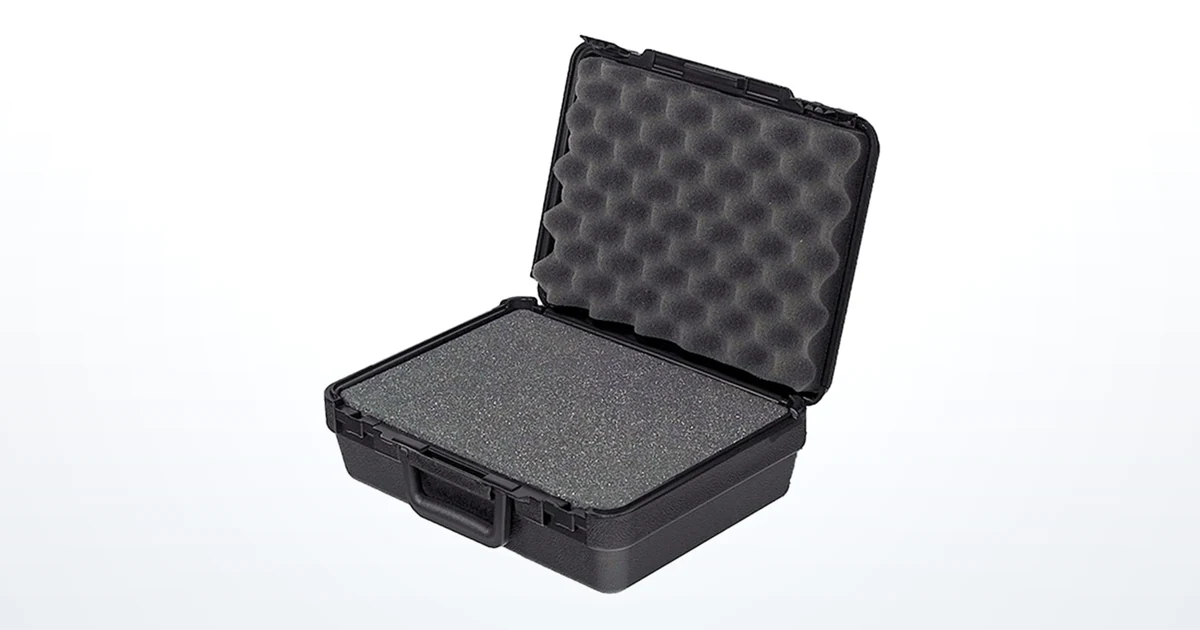
There is no price list for custom carrying cases, and any supplier who gives you a number before seeing your product is guessing. But the price is not mysterious either. Five things move it, and once you understand them you can usually tell roughly where your project will land before you ask anyone for a quote.
1. The shell: standard size or custom tooling
This is the biggest single decision, and it is binary. Either your product fits a case size that already exists, or a mold has to be cut for it.
There are more than 100 standard sizes across our four case families — 29 Classic and 7 Premier Blow Molded models (most in several depths), an Injection Molded line, 40 Thermoformed footprints from 5 1/8″ to 50″ long, and 24 Heavy Duty Watertight models. If one of them fits, you pay for cases and nothing else. No mold charge, no tooling amortization, no minimum tied to a tool.
That is why the first question we ask is always the dimensions of what you are protecting — not because we are stalling, but because the answer changes the shape of the whole quote. Our note on whether you actually need a custom mold walks through how to check.
2. Tooling, if you need it
A custom mold is a real, one-time cost, and it comes with a practical floor on quantity — for a custom Blow Molded tool, the minimum recommended production run is around 1,000 pieces. Below that, the tooling cost per case gets hard to justify, and a standard shell with a fully custom interior almost always wins on economics. See what blow molding costs for the factors on the manufacturing side.
3. The foam interior
The interior is usually the part people underestimate. Cost here is driven by three things:
- Foam type. Polyethylene is dense and durable; polyurethane (ester) foam is softer and better for fragile or awkward shapes. Neither is universally cheaper — it depends on density and thickness.
- How it is cut. Knife cutting suits prototypes and small runs, water-jet handles intricate cavity layouts, die cutting is the volume answer, and wire cutting handles unusually deep inserts with a one-time programming fee.
- How complex the layout is. A single cavity is cheap. Twelve cavities with undercuts, finger-pull reliefs and a second tier is not.
If your contents change from job to job, cubed foam or adjustable padded dividers are usually less expensive than a fully die-cut layout, and more flexible. Our guide to choosing custom foam inserts and the note on how foam is cut cover both in detail.
4. Branding
Hot stamping and molded-in logos are inexpensive per unit once set up. Engraving, printed and adhesive labels, logo plates and in-mold decorating all sit at different points on the scale, and custom molded colors carry their own setup. On Soft Sided cases, screen printing and embroidery price differently again. Putting your logo on a case goes through the options.
5. Quantity
Unit cost falls as volume rises — that is true of the cases, the foam and the branding setup. It is also the lever most buyers have the least flexibility on, which is why it is worth being honest about your real annual volume rather than quoting a first order in isolation. If you expect to reorder, say so; it changes what we recommend.
What we need in order to quote you properly
- The dimensions of everything going in the case, including accessories
- A photo or a drawing — a phone photo of the kit laid out is genuinely enough to start
- The quantity you need now, and the quantity you expect annually
- Where and how the case travels, and whether it has to be sealed
- Any branding or color requirements
With that, you get a real number instead of a range.
Get a real number for your project
Send us the dimensions, a photo or a drawing and the quantity you have in mind. If a standard size fits, we will tell you and save you the tooling.